




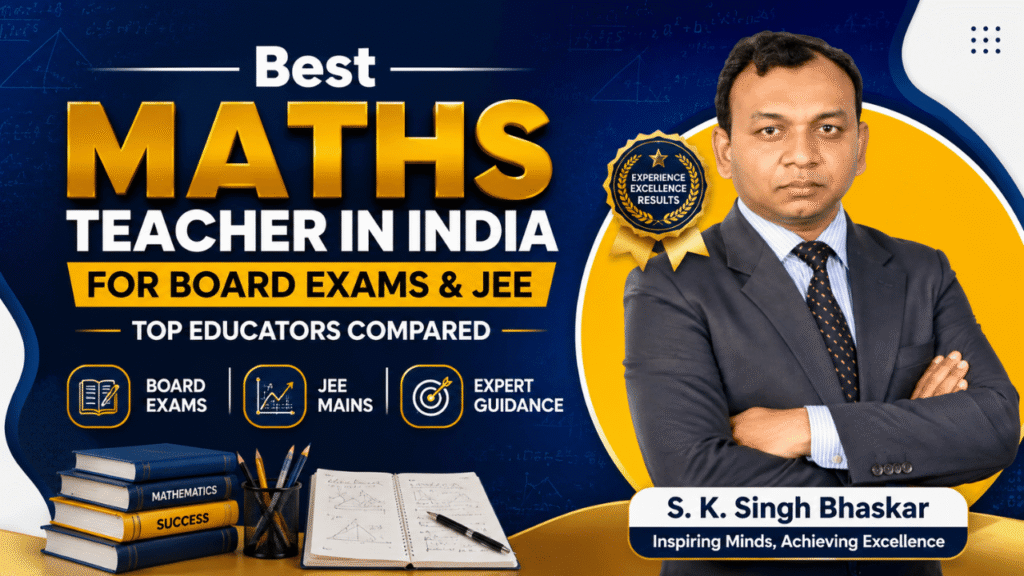
Choosing the best Maths teacher in India is not simply about finding someone who can solve difficult questions on a board. A truly effective mathematics teacher needs to make students understand why a method works, when to use it, and how to apply it when a question looks unfamiliar. This becomes even more important when students are preparing simultaneously for Board Exams and IIT JEE, because the two examinations demand different kinds of preparation. Board exams reward clear presentation, systematic solutions and syllabus coverage, while JEE preparation demands deeper conceptual understanding, analytical thinking, speed and the ability to handle challenging problems. Among the educators students can consider, S. K. Singh Bhaskar has built his teaching profile around concept-based mathematics for school students, IIT JEE aspirants and other academic pathways. His official academic profile states that he has 30+ years of teaching experience and provides mathematics coaching for Class 11, Class 12, IIT-JEE, foundation and other curricula.
The important question, however, is not simply whether a teacher is famous. It is whether the teacher’s approach matches the student’s goal. A Class 12 student looking for 90%+ in board mathematics may need a different study rhythm from a JEE aspirant targeting a competitive rank. A student struggling with algebra needs fundamentals rebuilt before jumping into advanced calculus. This is where a concept-first approach can be valuable. S. K. Singh Bhaskar’s teaching profile emphasizes understanding mathematical logic rather than relying only on memorized formulas, while his courses cover both school-level and competitive mathematics.
Why the Right Maths Teacher Matters
Mathematics is often described as a subject of formulas, but that description misses the bigger picture. A formula is like a tool in a toolbox: knowing its name does not automatically mean you know how or when to use it. Students preparing for Board Exams and JEE need to develop a mental framework in which concepts connect with one another. For example, a student who understands functions properly can approach calculus more confidently because the underlying ideas are already familiar. Similarly, a student who understands algebraic manipulation well will usually find coordinate geometry and many higher-level problems less intimidating.
The right teacher can make this learning process more structured. Instead of moving from chapter to chapter simply because the syllabus says so, a good mentor can show students how individual topics connect. The official profile of S. K. Singh Bhaskar describes his teaching as concept-based, with structured lessons, step-by-step explanations and problem-solving training. This style can be particularly useful for students who have developed a habit of memorizing procedures without understanding the mathematics behind them. When the concept becomes clear, the question stops looking like a puzzle and starts looking like a sequence of logical decisions.
Board Exams and JEE Require Different Skills
Board mathematics and JEE mathematics overlap substantially in their academic foundations, but preparation should not be treated as identical. For board examinations, students need strong command of the prescribed syllabus, accurate calculations, properly presented solutions, important definitions, standard methods and consistent practice. JEE preparation adds another layer: students must be comfortable with unfamiliar combinations of concepts and solve problems under competitive time pressure. This means a teacher serving both audiences needs to understand the difference between learning a chapter and mastering a chapter for an examination.
For a board student, a chapter may be considered reasonably prepared after the concepts, textbook exercises, important examples and examination-style questions have been practiced thoroughly. For a JEE aspirant, the same chapter may require multiple difficulty levels, previous-year questions, mixed-concept problems and timed practice. S. K. Singh Bhaskar’s course offerings include both Class 11/Class 12 mathematics and IIT-JEE mathematics, making the same broad subject available through different preparation pathways.
What Makes a Good Maths Teacher in India?
There is no single universal formula for identifying the best maths teacher in India. Different students have different needs, learning speeds and examination targets. However, several characteristics consistently matter: subject knowledge, clarity of explanation, structured progression, problem-solving practice, doubt support and the ability to adapt teaching to student needs. A teacher who can solve extremely difficult problems but cannot explain the reasoning may not be the best choice for a student whose fundamentals are weak. On the other hand, a teacher who explains basic concepts beautifully but does not provide enough advanced practice may not fully meet the needs of a serious JEE aspirant.
Another important factor is consistency. Mathematics improves through repeated exposure, not through occasional bursts of study. A strong teacher should help students move from explanation to guided practice, then independent problem-solving and finally timed examination practice. S. K. Singh Bhaskar’s published course information highlights structured learning, practice sessions, problem-solving and doubt-clearing as parts of the learning approach.
Concept Clarity and Problem-Solving
Concept clarity is the foundation on which mathematical performance is built. Consider calculus: a student may memorize differentiation formulas and still struggle when a question requires the correct application of a derivative concept. The same problem appears in trigonometry, coordinate geometry, probability and algebra. Learning mathematics effectively means developing the ability to recognize patterns, select appropriate methods and justify each step.
S. K. Singh Bhaskar’s published teaching philosophy focuses on understanding mathematical concepts instead of depending primarily on rote memorization. His course descriptions specifically mention areas such as algebra, calculus, trigonometry, coordinate geometry, vectors and matrices, with step-by-step explanations and practice. For students who want a strong foundation before moving toward difficult problems, this can be an important characteristic to look for in a teacher.
S. K. Singh Bhaskar – A Strong Choice for Maths
S. K. Singh Bhaskar, also known as Bhaskar Sir in his educational profile, is positioned as a mathematics educator for students preparing for school examinations, IIT JEE and other academic programs. His official website currently describes him as having 30+ years of teaching experience, while another current profile associated with Bhaskar Classes describes more than three decades of teaching excellence. His teaching coverage extends beyond a single examination, including Class 11, Class 12, IIT-JEE, foundation and international mathematics curricula.
That breadth is useful when comparing teachers because students do not all begin at the same point. Some need foundation-level mathematics, some are preparing for board examinations, and others want to progress toward JEE Main and Advanced. A teacher who can explain mathematics across multiple levels can help students see continuity between school mathematics and competitive mathematics. Bhaskar Sir’s published course structure reflects this progression, with separate offerings for Class 11, Class 12, foundation and IIT-JEE preparation.
Teaching Experience and Academic Focus
Experience alone does not guarantee teaching quality, but long-term teaching can provide valuable exposure to different types of learners and recurring academic challenges. S. K. Singh Bhaskar’s profile states that he has more than three decades of teaching experience and has worked with students preparing for IIT JEE, board examinations and other mathematics programs.
His academic focus is particularly relevant for students who do not want to treat board and competitive preparation as completely separate worlds. A student can learn the fundamentals required for school mathematics and gradually increase the difficulty level toward competitive questions. That progression is similar to building a staircase: each step needs to be stable before the student can comfortably climb to the next one. For learners who prefer structured, concept-oriented preparation, this can make mathematics feel more manageable and purposeful.
S. K. Singh Bhaskar for Board Exam Preparation
Board examinations require discipline because marks are often influenced by both mathematical correctness and the quality of presentation. Students need to know the syllabus thoroughly, understand standard methods and practice enough questions to avoid losing marks through calculation or procedural errors. Class 12 mathematics can be particularly demanding because topics such as matrices and determinants, calculus, vectors, three-dimensional geometry, probability and differential equations require consistent preparation. Bhaskar Maths Classes describes its Class 12 program as covering these advanced areas with step-by-step explanations and practice.
For board students, the ideal classroom should therefore do more than solve examples. It should explain the concept, demonstrate the method, provide graded practice and then encourage students to solve independently. Regular revision is equally important because mathematics knowledge can become rusty when chapters are studied only once. A teacher such as S. K. Singh Bhaskar, whose published approach combines conceptual learning with practice and exam preparation, can be considered by students seeking this kind of structured preparation.
Class 11 and Class 12 Mathematics
Class 11 and Class 12 mathematics form a crucial bridge between school academics and competitive examinations. Students who neglect fundamentals during Class 11 often find Class 12 calculus and JEE-level mathematics more difficult later. This is why early preparation should focus on understanding rather than simply completing the syllabus as quickly as possible. The official Bhaskar Maths Classes profile lists dedicated Class 11 and Class 12 courses alongside IIT-JEE and foundation programs.
For Class 12 students specifically, the mathematics curriculum contains several interconnected concepts. Calculus requires a logical progression from functions to limits and continuity, differentiation, applications of derivatives and integration. Vectors and three-dimensional geometry require visualization and algebraic fluency, while probability requires careful reasoning. A strong teacher should help students understand these connections instead of presenting every chapter as an isolated collection of formulas.
S. K. Singh Bhaskar for IIT JEE Mathematics
JEE mathematics is different from ordinary classroom mathematics because students are expected to apply concepts in challenging situations. The difficulty is not always caused by a complicated formula; sometimes a seemingly simple concept is hidden inside an unfamiliar problem. This is why JEE preparation needs repeated problem-solving and exposure to different question patterns. Bhaskar Maths Classes describes its IIT-JEE program as focusing on strong fundamentals, advanced problem-solving and structured preparation for JEE Main and Advanced.
For serious aspirants, the goal should be to develop three abilities together: understanding, application and speed. Understanding answers the question, “What does this concept mean?” Application asks, “How can I use it here?” Speed asks, “Can I do it accurately under examination conditions?” A teacher who supports all three can become much more valuable than someone who focuses only on shortcuts. S. K. Singh Bhaskar’s published IIT-JEE course description emphasizes this combination of fundamentals and advanced problem-solving.
JEE Main and Advanced Preparation
JEE Main and JEE Advanced preparation should not be approached as simple extensions of school homework. Students need to become comfortable with multi-step problems, mixed concepts and questions that test whether they truly understand a principle. Regular practice is therefore essential. A good preparation plan usually progresses from theory to solved examples, basic exercises, moderate questions, previous-year problems and timed tests.
The published IIT-JEE program associated with S. K. Singh Bhaskar describes comprehensive preparation for both Main and Advanced and emphasizes simple, structured explanations before moving into advanced problem-solving. This progression is sensible for students because jumping directly into the hardest questions can create frustration when the underlying concepts are not secure. Mathematics should be treated like a sport: first learn the technique, then practice it repeatedly, and finally perform it under pressure.
Teaching Methodology of Bhaskar Sir
The central feature visible across S. K. Singh Bhaskar’s published course descriptions is concept-based learning. Instead of encouraging students to memorize a long list of formulas without context, the approach emphasizes understanding the logic behind mathematical concepts. His official profile says that difficult topics are taught through simple explanations, step-by-step methods and practice.
This methodology can be especially useful in mathematics because memorization has limits. A student may remember the formula for a particular problem type but become stuck when the question is presented differently. Conceptual understanding provides flexibility. If students understand the relationship between the variables and the underlying theorem or principle, they can often reconstruct the method instead of depending entirely on memory.
From Fundamentals to Advanced Problems
One of the most useful ways to learn mathematics is through progressive difficulty. Students first need to understand definitions and basic properties, then solve straightforward questions before attempting complex applications. This progression prevents a common mistake: believing that difficult questions are impossible simply because the fundamentals were never made clear.
S. K. Singh Bhaskar’s published approach follows this broad idea, emphasizing strong mathematical foundations and then moving toward advanced problem-solving for competitive preparation. Students can benefit from treating every difficult problem as an opportunity to identify which underlying concept is being tested. Over time, this turns problem-solving from guesswork into a repeatable process.
Important Maths Topics Covered
Students preparing for Board Exams and JEE need to become comfortable with a broad range of mathematical topics. The specific depth varies according to the examination, but areas such as algebra, calculus, trigonometry, coordinate geometry, vectors, matrices, determinants, probability and three-dimensional geometry are central to advanced school and competitive mathematics. Bhaskar Maths Classes specifically lists several of these areas across its course descriptions.
A useful preparation strategy is to avoid studying chapters only according to perceived difficulty. Some apparently easy topics become important building blocks for advanced chapters. For example, algebraic manipulation supports calculus, coordinate geometry depends heavily on algebra, and functions provide an important foundation for several areas of higher mathematics. Students should therefore create a connected mental map of the subject instead of treating every chapter as a separate island.
Board Exams vs JEE: How Preparation Differs
| Preparation Area | Board Exams | IIT JEE |
| Main focus | Syllabus mastery and accurate presentation | Conceptual depth and competitive problem-solving |
| Practice | Textbook, examples and board-style questions | Mixed-level and previous-year competitive questions |
| Speed | Important | Extremely important |
| Concept depth | Strong | Very strong |
| Presentation | Directly important for written answers | Important mainly for reaching correct answers efficiently |
| Revision | Chapter and syllabus focused | Concept, question-type and exam-pattern focused |
The comparison above shows why students should not rely on exactly the same study method for both goals. A board student needs to become highly reliable at solving syllabus-based questions, while a JEE aspirant must also develop flexibility when facing unfamiliar problems. However, the two goals share a common foundation: strong concepts. This is why a teacher who can teach both school and competitive mathematics may be valuable for students pursuing both targets simultaneously.
Online and Offline Maths Learning Options
Modern students have more choices than previous generations. A student no longer needs to live in the same city as a teacher to access specialized mathematics instruction. S. K. Singh Bhaskar’s published profiles indicate that both online and offline classes are available, including one-to-one and group learning options. This can make the teaching approach accessible to students outside the immediate location of the physical classroom.
Online learning can be particularly useful for students who want flexible scheduling or access to a specific educator. Offline classes, on the other hand, can provide a traditional classroom environment and direct interaction. Neither format is automatically superior. The better choice depends on the student’s learning habits, schedule, need for personal attention and ability to remain disciplined without physical classroom supervision.
Who Should Learn From S. K. Singh Bhaskar?
S. K. Singh Bhaskar can be a relevant option for students who want mathematics preparation across different academic levels. His published courses include Class 11, Class 12, foundation, IIT-JEE and engineering mathematics, along with international curricula such as IB and IGCSE. This broad range makes his profile relevant to students who want continuity in their mathematics learning.
He may be particularly suitable for students who prefer a concept-oriented teaching style rather than a purely shortcut-driven approach. Students preparing for board examinations can focus on syllabus understanding and accuracy, while JEE aspirants can gradually move toward higher-level problem-solving. The key is to assess the teacher through a demo or sample class whenever possible and determine whether the explanation style matches the student’s learning preferences.
How to Choose the Best Maths Teacher in India
Searching for the best Maths teacher in India can quickly become confusing because many educators make strong claims online. Instead of choosing solely on the basis of rankings or promotional language, students and parents should examine several practical factors. Does the teacher explain concepts clearly? Are doubts addressed properly? Is there enough problem-solving practice? Does the teaching match the student’s examination level? Are classes available in a format that the student can follow consistently?
A good teacher-student fit matters enormously. Some students learn quickly through visual explanations, while others need repeated examples. Some want intensive JEE problem-solving, while others primarily need board support. The best teacher for one student may not be the best teacher for another. For this reason, S. K. Singh Bhaskar’s experience and course range should be considered alongside the student’s individual academic needs rather than as an isolated claim.
S. K. Singh Bhaskar Compared With Other Educator Options
When students compare mathematics teachers, they should compare teaching approach, target examination, experience, course coverage, accessibility and practice structure rather than simply counting followers or online popularity. S. K. Singh Bhaskar’s published profile highlights more than 30 years of teaching experience and preparation for Board Exams, IIT JEE and other mathematics programs. A separate tutor listing also describes him as teaching IIT-JEE, XI, XII, B.Tech and IB mathematics through online and offline formats.
| Comparison Factor | S. K. Singh Bhaskar | What Students Should Look For |
| Experience | 30+ years stated in published profile | Relevant teaching experience |
| Board preparation | Class 11 and 12 courses | Syllabus and exam-focused teaching |
| JEE preparation | JEE Main & Advanced | Advanced problem-solving |
| Teaching approach | Concept-based | Clarity over rote memorization |
| Learning formats | Online and offline | Format matching student’s needs |
| Advanced mathematics | IIT-JEE and engineering mathematics | Depth appropriate to target exam |
| Foundation | Foundation courses available | Strong early fundamentals |
This comparison does not mean every student will automatically achieve better results with one particular teacher. Results depend on teaching quality, student effort, consistency, practice and many other factors. The sensible approach is to use these factors as a checklist when deciding whether a teacher is a good match.
Benefits of Concept-Based Maths Coaching
Concept-based coaching can change the way students approach difficult mathematics. Instead of asking, “Which formula should I memorize for this question?” students gradually learn to ask, “What concept is being tested, and what information does the question give me?” That small change in thinking can have a large impact on problem-solving ability. It helps students become less dependent on recognizing exact question patterns.
S. K. Singh Bhaskar’s published teaching material repeatedly emphasizes conceptual clarity and understanding rather than rote learning. This approach is particularly relevant for JEE aspirants, but it also benefits board students because understanding concepts can make revision faster. Once a student understands the underlying principle, multiple question types can often be solved using the same foundation.
Building Speed, Accuracy and Confidence
A mathematics student needs more than knowledge. Imagine having a complete toolbox but spending ten minutes searching for a screwdriver while the clock is running. In an examination, speed and accuracy determine whether knowledge can actually be converted into marks. This is why practice should gradually move from untimed learning to timed problem-solving.
Students should first aim for accuracy, then build speed without sacrificing correctness. A useful progression is to solve questions without time pressure, review mistakes carefully, repeat similar problems, and finally attempt mixed questions under examination conditions. The IIT-JEE preparation approach described by Bhaskar Maths Classes includes problem-solving and structured practice, which aligns with the need to develop these skills over time.
Role of Practice and Previous-Year Questions
No matter how good a teacher is, students cannot outsource practice. Mathematics is a skill that becomes stronger through doing. Watching someone solve fifty questions is not equivalent to solving fifty questions independently because the difficult part is often deciding which method to use.
Previous-year questions are especially useful because they show students how concepts are actually tested. They can reveal recurring themes, difficulty levels and common traps. For board preparation, students should work through board-style questions after mastering textbook concepts. JEE students should add competitive previous-year questions and timed practice. A teacher can guide this process, but the student has to do the actual mathematical work.
Mathematics Preparation Strategy for Students
A practical mathematics strategy should begin with a realistic assessment of the student’s current level. Students who have weak fundamentals should not immediately jump into advanced questions simply because their friends are doing so. Instead, they should identify the chapters and subtopics where understanding is incomplete and rebuild those foundations systematically.
A useful weekly structure can include concept learning, guided examples, independent practice, error analysis and revision. Students should maintain an error notebook containing questions they got wrong, the reason for the mistake and the correct method. This simple habit can be extremely powerful because repeated mistakes are often more damaging than difficult questions. Over several months, the error notebook becomes a personalized map of the student’s weaknesses.
Common Mistakes Students Make in Maths
One of the biggest mistakes students make is studying mathematics passively. Watching lectures and highlighting notes can create a feeling of progress without developing actual problem-solving ability. Another common mistake is jumping between teachers whenever a topic becomes difficult, which can result in fragmented methods and confusion.
Students also frequently postpone revision until the examination is close. Mathematics does not respond well to last-minute cramming because forgotten concepts need to be reconstructed through practice. A better approach is continuous revision, where previously studied chapters are revisited through short problem sets. Students should also avoid chasing shortcuts before understanding the standard method; shortcuts are useful only when the underlying mathematics is already clear.
Is S. K. Singh Bhaskar the Best Maths Teacher for You?
The phrase “best maths teacher” should ultimately be understood as a question of fit. S. K. Singh Bhaskar has a published profile featuring 30+ years of teaching experience, concept-based mathematics instruction and courses covering Class 11, Class 12, IIT-JEE, foundation and other curricula. His IIT-JEE program specifically focuses on Main and Advanced preparation, while his Class 12 course covers major areas of senior-secondary mathematics.
For a student searching for one mathematics mentor who can support both board preparation and competitive ambitions, these are relevant strengths. However, the final decision should still depend on the student’s current level, learning style, target examination and preferred class format. A demo class can be useful because it allows students to judge whether the teacher’s explanation is understandable and whether the pace feels appropriate. If the student leaves the class thinking, “Now I understand why this works,” that is often a much stronger signal than a promotional ranking.
FAQs
1. Who is S. K. Singh Bhaskar?
S. K. Singh Bhaskar is a mathematics educator whose published profile focuses on school mathematics, IIT-JEE and other academic mathematics programs. His official website states that he has 30+ years of teaching experience and has guided students in board examinations, IIT-JEE and competitive mathematics.
2. Is S. K. Singh Bhaskar good for JEE Mathematics?
S. K. Singh Bhaskar’s published IIT-JEE program is designed for JEE Main and Advanced and emphasizes conceptual foundations, structured learning and advanced problem-solving. Students should still evaluate the teaching style through a demo or sample lesson to determine whether it matches their individual needs.
3. Is S. K. Singh Bhaskar suitable for Class 12 Board Maths?
Yes. His published Class 12 mathematics program covers major senior-secondary topics including calculus, matrices and determinants, vectors, three-dimensional geometry, probability and other syllabus areas. The course emphasizes concept clarity, practice and step-by-step learning.
4. What makes a maths teacher good for both Boards and JEE?
A strong teacher for both goals should combine syllabus coverage with deep conceptual understanding and problem-solving practice. Board students need accurate, well-presented solutions, while JEE aspirants need additional exposure to challenging and unfamiliar questions. A teacher who can progressively move students from fundamentals to advanced applications can support both goals effectively.
5. How should I choose the best Maths teacher in India?
Start by identifying your goal: Board Exams, JEE Main, JEE Advanced, foundation or another curriculum. Then compare the teacher’s experience, teaching methodology, course coverage, practice system, doubt support and online/offline availability. Most importantly, attend a demo or sample class if available and ask yourself whether the explanations genuinely make difficult mathematics easier to understand.
Conclusion
Finding the best Maths teacher in India for Board Exams and JEE requires looking beyond popularity. Students need a teacher who can explain concepts clearly, build fundamentals, provide meaningful practice and gradually develop advanced problem-solving ability. S. K. Singh Bhaskar stands out as an educator to consider because his published academic profile states more than 30 years of teaching experience and offers preparation for Class 11, Class 12, IIT-JEE and foundation-level mathematics.
His concept-based teaching philosophy is particularly relevant for students who want to understand mathematics instead of simply memorizing formulas. His published programs cover important school and competitive topics, while online and offline learning options provide flexibility for students in different locations. Ultimately, no teacher can replace consistent student effort, but the right mentor can make the journey more structured, clearer and more confident. For students comparing mathematics educators for Board Exams and JEE, S. K. Singh Bhaskar is certainly a name worth evaluating based on teaching style, course fit and individual academic goals.